(SEPT 25) For much of its history, women’s boxing has been defined not by the triumphs in the ring, but by the struggle to be taken seriously outside of it. From its earliest days, female fighters faced ridicule, legal bans, and cultural stereotypes that sought to keep them out of the sport. Yet, through persistence and resilience, they carved a path that has transformed women’s boxing from sideshow spectacle to a legitimate athletic pursuit.
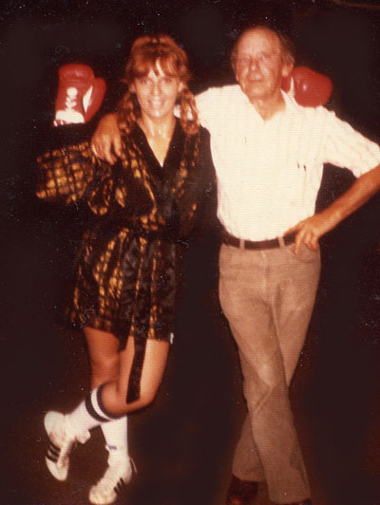
Photo of Sue TL Fox, posing with her father before she
fought Gwen Gemini at the Expo Center in Portland, Oregon in Late 1970’s.
The early history of the sport was captured by Women Boxing Archive Network (WBAN), after Sue TL Fox, began to reveal the history in February of 1998, when she went live on the Internet with the website womenboxing.com.
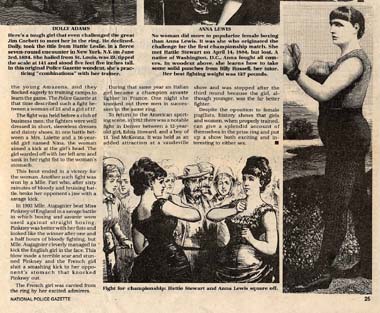
In the 18th and 19th centuries, women who boxed were treated as novelties rather than female boxers. Matches were staged at fairs or circuses, drawing crowds more for the curiosity of watching women fight than for the skill on display. Since this time there has been many books written about the struggles on the early trailblazing pioneers of these events that took place at this time.
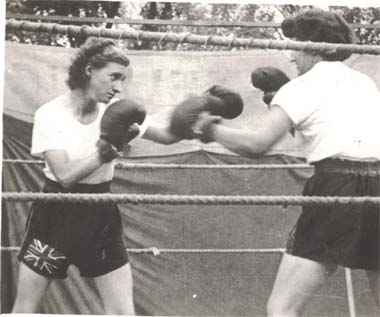
Barbara Buttrick fighting an unknown female boxer 1950s
The early 20th century brought little relief. Even as boxing grew into a highly organized and celebrated sport for men, women were locked out by athletic commissions and legislative bans. Those who pressed on, such as Barbara Buttrick in the 1940s and 50s, had to tour outside of the mainstream, fighting on the margins where recognition was scarce.
By the 1970s, women began to win small victories, with fighters like Cathy “Cat” Davis, Pat Pineda, and others securing licenses to compete. Still, much of the media focused on the negative of women trying to boxing professionally, and admittedly many were not highly skilled when turning pro, as with females they were not allowed to be an amateur like their male counterparts. So many female boxers were ridiculed for how they looked and boxed in this era.
The closing decades of the 20th century saw the beginnings of real change. Champions like Christy Martin, Lucia Rijker, Laila Ali, Regina Halmich, Bonnie Canino, Kathy Collins, Jane Couch, Daisy Lang, and more,denied the opportunity to compete on the sport’s biggest stage—the Olympics. Even as their matches drew crowds, the financial rewards lagged far behind those of their male counterparts. Women could not compete in the Olympics until the 2012 Olypmpics, in only three weight classes, with 36 amateur female boxers able to compete.
Only in the 21st century did women’s boxing begin to receive overdue recognition. The inclusion of women’s boxing in the 2012 London Olympics was a landmark, producing champions like NIcola Adams, Claressa Shields, and Katie Taylor, and many more amateur boxers, who proved beyond doubt that women belonged on boxing’s grandest stage. Professional bouts featuring women began to headline major cards, and stars like Amanda Serrano elevated the sport further.
Still, the fight for respect is not over in some of the events that take place in the sport. We continue to see at times questionable mismatches, fighters fighting for titles, with inferior opponents, and which leads to a black eye in the sport.